
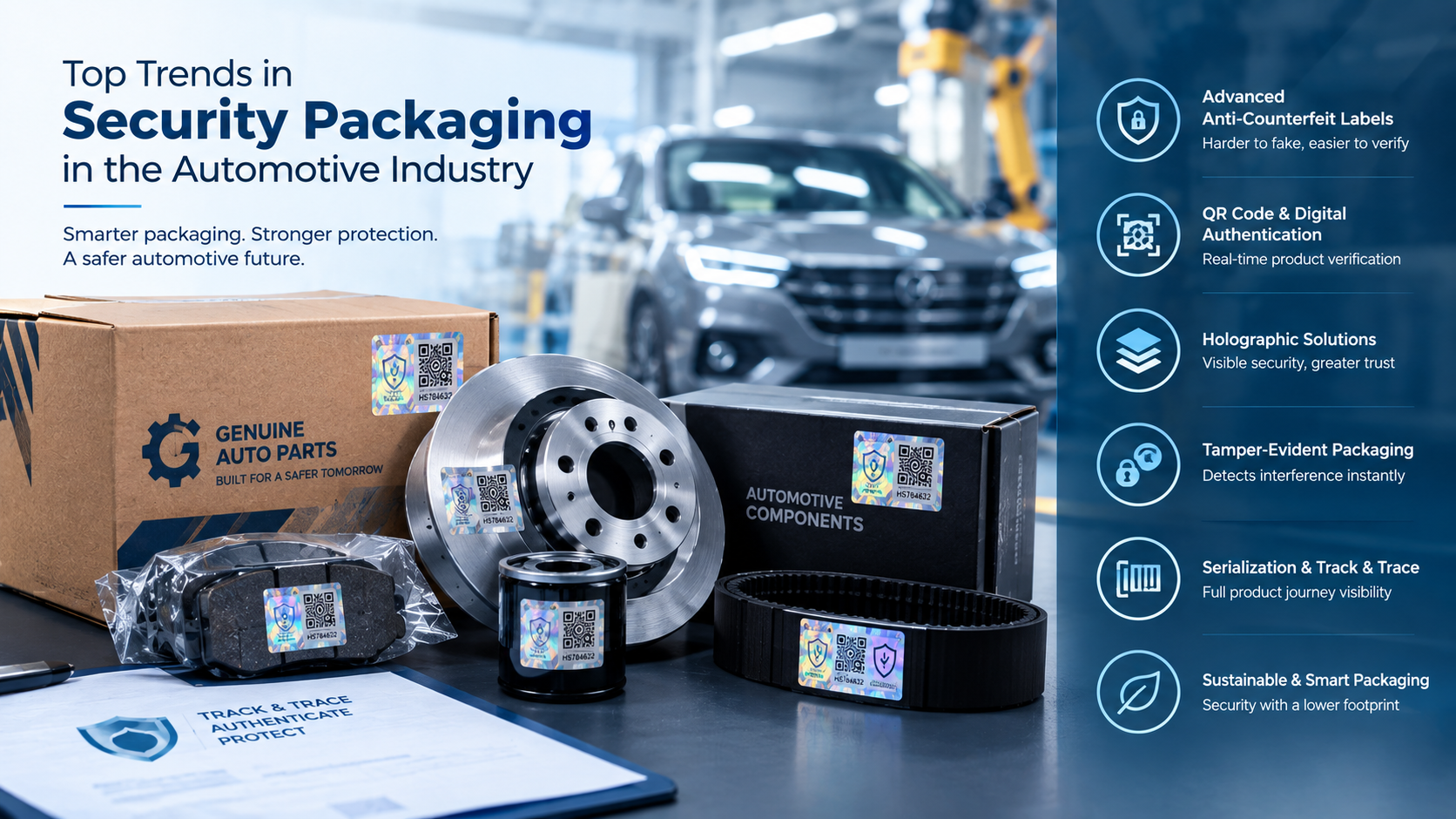
Counterfeiting has become a growing concern across the automotive aftermarket.
From filters and lubricants to electrical components, spare parts and replacement products, counterfeit automotive products can enter distribution networks and reach workshops, dealers and customers through increasingly sophisticated channels.
For automotive component manufacturers, packaging is therefore becoming more than a way to protect a product during transportation.
It is becoming an important part of brand protection, product authentication, supply-chain visibility and counterfeit prevention.
As counterfeiters become more sophisticated, automotive brands are adopting technologies such as serialization, barcode authentication, track and trace, tamper-evident security and digital product verification.
Here are some of the key trends shaping automotive security packaging.
Trend 1: Serialization Is Becoming a Core Security Layer
Serialization was once primarily associated with high-value products and specialized applications.
Today, more automotive manufacturers are using unique product identification across a wider range of SKUs.
A serialized product receives a unique identity rather than relying solely on a common product code or batch number.
This can help brands:
- Identify individual products
- Support authentication
- Monitor product movement
- Detect duplicate codes
- Improve supply-chain visibility
- Investigate counterfeit activity
Secure Packaging Solutions for Auto Industry applications can incorporate serialized numbers, QR codes, barcodes and other unique identifiers depending on the product and authentication requirements.
The shift is significant because even relatively low-cost components can be attractive targets for counterfeiters when produced and distributed at large volumes.
Trend 2: Barcodes Are Becoming Part of Product Security
Barcodes have traditionally been associated with inventory and logistics.
Their role is expanding.
Today, Automotive Barcode Labels Manufacturers in Noida can develop labels where barcode-based identification becomes part of a broader product-security strategy.
Depending on the system, a barcode can help authorized stakeholders access information such as:
- Product identity
- SKU information
- Batch details
- Manufacturing information
- Distribution data
- Authentication status
This means a distributor; dealer or service professional may be able to scan a component before installation rather than relying entirely on visual inspection.
Barcode technology can therefore serve two purposes:
Operational identification + Product authentication
Trend 3: QR Authentication Is Moving Closer to the Product
QR codes are becoming increasingly common in automotive packaging because they can connect physical products with digital information.
A unique QR code can provide a digital identity that can be accessed using a smartphone or scanning device.
QR Code Authentication in India can support applications where distributors, dealers, mechanics or customers need to verify product information before installation or purchase.
Depending on the system, authentication can provide:
- Product verification
- Product information
- Manufacturing details
- Batch information
- Installation information
- Warranty-related information
- Authentication status
For high-risk components, QR authentication can also be combined with serialization, holographic security and tamper-evident labels.
Trend 4: Track and Trace Is Expanding Across the Automotive Supply Chain
Supply-chain visibility is becoming increasingly important for automotive component manufacturers.
Previously, product visibility might have ended once the manufacturer handed the shipment to a distributor.
Modern Track and Trace Labels in India can support visibility across multiple stages:
Manufacturer → Warehouse → Distributor → Dealer → Service Centre → Customer
Each scan can potentially create a record containing information about the product and its movement.
This can help brands identify:
- Unexpected distribution routes
- Unauthorized-market activity
- Duplicate scans
- Unusual product movement
- Suspicious authentication activity
- Potential diversion
The result is a shift from simply knowing how many products were shipped to having greater visibility into where products are appearing throughout the distribution network.
Trend 5: Durability Is Becoming a Security Requirement
Automotive products operate in significantly harsher environments than many conventional consumer products.
Security labels used on or around automotive components may encounter:
- Engine heat
- Oil
- Grease
- Chemicals
- Moisture
- Dust
- Vibration
- Abrasion
- Temperature fluctuations
- Long storage periods
A security label that performs well on a retail shelf may not perform equally well in an automotive environment.
This is why Track and Trace Labels Manufacturer in India solutions for automotive applications increasingly need to consider durability alongside security.
The label must remain identifiable and scannable throughout its intended lifecycle.
For applications involving under-hood or under-chassis environments, material selection, adhesive performance, print durability and barcode or QR readability should be validated under realistic conditions.
Trend 6: Tamper-Evident Security Is Becoming More Important
Counterfeiters do not always manufacture completely new packaging.
In some cases, genuine packaging can be opened, reused or refilled.
Tamper-evident security can help address this vulnerability.
Automotive packaging can incorporate:
- VOID labels
- Destructible labels
- Tamper-evident seals
- Security cuts
- Residue-based technology
- Holographic tamper labels
If the package is opened or the label is removed, the security feature can reveal evidence of interference.
For automotive lubricants, spare parts and other products where packaging reuse is a concern, tamper-evident technology can provide an additional layer of protection.
Trend 7: Holographic Security Is Becoming More Customized
Generic holograms are increasingly being replaced by brand-specific security designs.
A customized holographic feature can become a recognizable authentication marker for a particular automotive brand or product range.
Hologram Security Solutions can incorporate features such as:
- Custom holographic artwork
- 2D and 3D effects
- Kinetic effects
- Micro text
- Brand-specific patterns
- Variable information
- Tamper-evident construction
The objective is not simply to make packaging look premium.
The holographic feature should help authorized users distinguish genuine products from suspicious packaging.
For high-risk components, holographic security can be combined with digital authentication to create both physical and digital verification.
Trend 8: Physical and Digital Security Are Converging
One of the most important developments in automotive packaging security is the combination of physical and digital technologies.
A modern security label may combine:
Hologram + Tamper Evidence + Serialization + QR Code + Track & Trace
Each layer serves a different purpose.
The hologram provides visible authentication.
Tamper evidence indicates whether packaging has been opened.
Serialization gives the product a unique identity.
The QR code connects the physical product with a digital system.
Track and trace provides visibility into relevant product movements and scan events.
This layered approach is increasingly becoming the foundation of modern Product Security Labels in India.
Trend 9: Security Data Is Becoming a Business Intelligence Tool
Collecting scans is only the beginning.
The next step is using that information to identify patterns.
Modern track-and-trace systems can help brand teams investigate:
- Duplicate product scans
- Unexpected geographic locations
- Unusual scan frequency
- Unauthorized distribution
- Product diversion
- Suspicious authentication activity
For example, if a product intended for one region suddenly appears in multiple distant locations, the brand may investigate whether the product has been diverted or whether its identifier has been copied.
This makes packaging security part of the brand’s broader supply-chain intelligence system.
Trend 10: Consumer Verification Is Becoming More Accessible
Automotive product authentication is no longer limited to manufacturers and distributors.
Consumers are increasingly becoming part of the verification process.
A customer purchasing an expensive spare part may want to confirm that the product is genuine before installation.
A QR-enabled Product Authentication Label can provide an additional verification point.
Depending on the system, the customer may be able to check:
- Product authenticity
- Product identity
- Manufacturing information
- Batch information
- Verification status
- Brand information
This can help create greater transparency between the automotive brand and the end customer.
What These Trends Mean for Automotive Component Manufacturers
The biggest change is that packaging security is moving from a collection of individual features toward an integrated system.
A barcode alone may identify a product.
A hologram may provide visual authentication.
A tamper-evident label may show whether packaging has been opened.
A QR code may provide digital verification.
Track and trace may provide supply-chain visibility.
But when these technologies work together, they can create a considerably stronger automotive product security strategy.
The right combination depends on the product, counterfeit risk, packaging format and distribution model.
How to Choose the Right Automotive Security Packaging?
Before selecting a security label or authentication technology, automotive manufacturers should evaluate several factors.
1. Product Risk
Identify which components are most vulnerable to counterfeiting, substitution or unauthorized distribution.
2. Packaging Environment
Consider heat, oil, chemicals, moisture, vibration, abrasion and storage conditions.
3. Authentication Requirement
Determine whether authentication is required only for internal teams or should also be available to distributors, mechanics and customers.
4. Supply-Chain Complexity
The more distributors and channels involved, the more valuable track and trace can become.
5. Label Durability
The label should remain readable and functional for the required period.
6. Scalability
The system should be capable of handling multiple SKUs, large production volumes and future product expansion.
7. Integration
For larger automotive manufacturers, consider whether the security system can integrate with existing ERP, warehouse, production or distribution processes.
The Future of Automotive Packaging Security
The future is moving toward connected product security.
Instead of treating the package as a passive container, automotive brands are increasingly turning it into an active authentication and identification point.
A single product package can potentially provide:
Physical Authentication + Tamper Evidence + Unique Identity + Digital Verification + Supply-Chain Visibility
This creates a security ecosystem that can continue generating useful information after the product leaves the factory.
For automotive manufacturers, the goal is not simply to make counterfeit products harder to copy.
It is to make genuine products:
Easy to identify. Easy to authenticate. Difficult to reuse. Difficult to replicate. Easier to trace.
Why Holosafe for Automotive Security Packaging?
Holosafe develops automotive packaging security solutions designed around the specific conditions and risks associated with automotive supply chains.
Depending on the application, solutions can incorporate:
- Secure Packaging Solutions for Auto Industry
- Automotive barcode labels
- Serialized security labels
- Track and trace labels
- QR authentication
- Holographic security
- Tamper-evident labels
- Product authentication
- Brand protection features
For demanding automotive applications, the security construction can be evaluated against the actual packaging material and expected environmental conditions.
The objective is to combine durability, authentication and traceability rather than treating them as separate requirements.
Talk to Holosafe about upgrading your automotive packaging security with a solution designed for your product, supply chain and counterfeit-risk profile.