
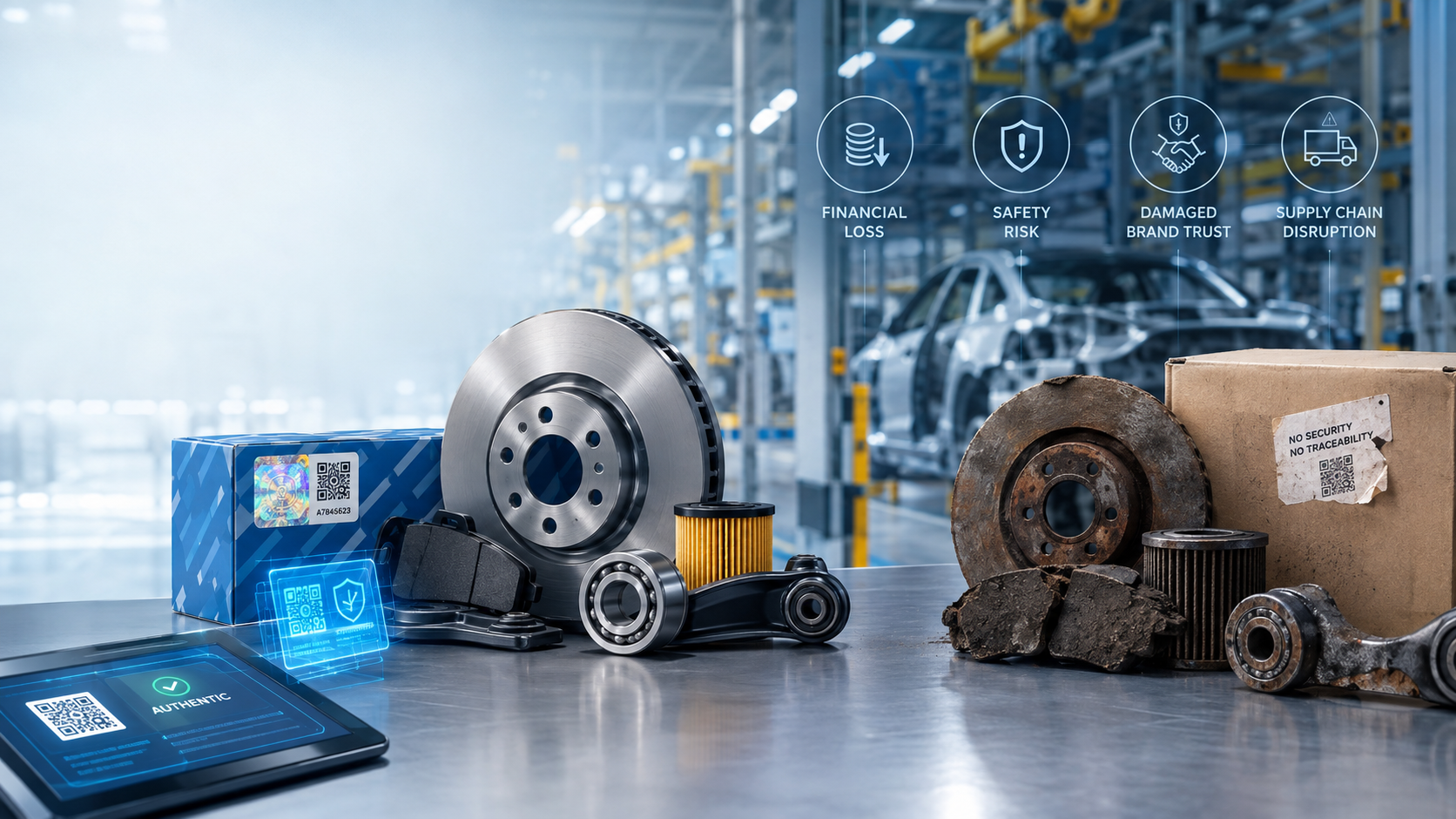
Counterfeit auto components are more than a commercial problem. A fake brake pad, steering component, bearing, filter or other spare part can look almost identical to the genuine product while failing under real-world conditions.
For automotive manufacturers, the consequences can extend from lost revenue and increased warranty costs to reputational damage and serious safety risks.
As automotive supply chains become more complex, manufacturers need to build product security into packaging, identification and distribution systems rather than relying only on enforcement after counterfeit products appear.
1. Financial Losses Go Beyond Lost Sales
Every counterfeit component sold can represent a lost legitimate sale, but the financial impact often continues after the initial transaction.
Counterfeit products can contribute to:
- Lost revenue
- Increased warranty claims
- Product returns
- Customer complaints
- Investigation costs
- Distributor disputes
- Brand-protection expenses
A customer who unknowingly purchases a counterfeit part may approach the genuine manufacturer when the product fails, leaving the brand to address a problem it did not create
2. Counterfeit Parts Can Create Safety Risks
The consequences become more serious when counterfeit components affect vehicle safety or performance.
A counterfeit part may not meet the specifications, materials or manufacturing tolerances expected from the genuine component. Depending on the application, this can affect braking, steering, suspension, engine performance or other critical systems.
A component failure can therefore result in more than a quality complaint. It can create potential safety incidents and associate the genuine brand with a product it never manufactured.
This makes automotive product authentication and counterfeit prevention important for both commercial and safety reasons.
3. Counterfeiting Creates Distribution Blind Spots
Automotive products can pass through several stages:
Manufacturer → Warehouse → Distributor → Dealer → Workshop → Customer
Every handoff can create an opportunity for counterfeit or unauthorized stock to enter the network.
Without sufficient product identification and supply-chain visibility, manufacturers may struggle to determine:
- Where the counterfeit entered
- Which channel handled it
- Which markets are affected
- Whether the issue is isolated or widespread
This lack of visibility can make containment considerably more difficult.
4. Build Anti-Counterfeit Protection into the Packaging
Counterfeit prevention can begin at the factory rather than after an incident.
Anti-Counterfeit Packaging Labels in India can incorporate a combination of physical and digital security technologies, including:
- Holographic security
- Tamper-evident labels
- Destructible constructions
- Serialization
- QR authentication
- Barcodes
- Track and trace
- Covert security features
The objective is to make genuine products easier to authenticate and counterfeit products more difficult to reproduce or pass through authorized channels.
5. Tamper Evidence Helps Prevent Packaging Reuse
Counterfeiters do not always need to reproduce an entire package. Genuine automotive packaging can potentially be opened, reused and filled with counterfeit or inferior components.
Tamper-evident Product Security Labels in India can make unauthorized opening visible through features such as:
- VOID messages
- Label destruction
- Security cuts
- Residue
- Fracturing
For products where packaging reuse is a concern, this provides an additional layer of protection.
6. Serialization and Digital Authentication Create Product-Level Security
Traditional packaging may identify only a product model or batch. Serialization can give individual products unique identities.
This enables brands to support:
- Product authentication
- Duplicate-code detection
- Product-level traceability
- Distribution monitoring
- Counterfeit investigation
Secure Packaging Solutions for Auto Industry applications can incorporate serialized numbers, barcodes or QR codes according to the product’s risk profile.
A unique QR code can connect the physical product to a digital authentication system, allowing distributors, dealers, mechanics or customers to verify relevant product information.
The important distinction is that the security comes from the authentication system behind the identifier, not simply from printing a QR code.
7. Track and Trace Improves Supply-Chain Visibility
Serialization becomes more valuable when connected to track and trace.
Track and Trace Labels in India can associate products with digital records and capture relevant scan events across the distribution network.
For example:
Manufacturer → Warehouse → Distributor → Dealer → Service Centre
Unusual activity — such as a product appearing in an unexpected region or a code being scanned repeatedly — can be investigated as a potential sign of diversion, duplication or unauthorized distribution.
This shifts counterfeit management from simply identifying fake products to understanding where and how they entered the market.
8. Automotive Security Labels Must Survive Real Conditions
Security technology is only useful if the label remains functional in its intended environment.
Automotive packaging and components may encounter:
- Heat
- Oil and grease
- Chemicals
- Moisture
- Dust
- Vibration
- Abrasion
- Temperature fluctuations
- Long storage periods
Labels should therefore be evaluated for adhesion, print durability, barcode or QR readability and tamper performance under the actual conditions of use.
The appropriate construction should be tested on the real packaging material rather than selected solely from a standard specification sheet.
9. A Layered Security Strategy Is Stronger
No single technology addresses every counterfeit risk.
A comprehensive automotive product-security system can combine:
Hologram + Tamper Evidence + Serialization + QR/Barcode Authentication + Track & Trace
Each layer serves a different purpose:
- Hologram: visible authentication
- Tamper evidence: indicates packaging interference
- Serialization: gives products unique identities
- QR/Barcode: enables machine-readable identification and verification
- Track & Trace: provides supply-chain visibility
The right combination depends on the product, counterfeit risk, packaging format and distribution model.
What Automotive Manufacturers Should Evaluate
Before selecting a security solution, manufacturers should assess:
Product Risk
Which components are most vulnerable to counterfeiting, substitution or unauthorized distribution?
Distribution Risk
Which regions, distributors and channels have the greatest exposure?
Authentication
Should verification be available only to internal teams, or also to dealers, mechanics and customers?
Packaging Reuse
Can genuine packaging be opened and reused without detection?
Environmental Conditions
Will the label face heat, oil, chemicals, moisture, vibration or abrasion?
Traceability
Would product-level identification and scan data improve visibility across the distribution network?
These questions help determine whether the application requires basic tamper evidence or a more comprehensive combination of physical and digital security.
How Holosafe Helps Protect Auto Components
Holosafe develops automotive packaging security solutions designed around the risks and operating conditions of automotive supply chains.
Depending on the application, solutions can include:
- Anti-Counterfeit Packaging Labels in India
- Secure Packaging Solutions for Auto Industry
- Product Security Labels in India
- Automotive barcode labels
- Serialized security labels
- Track and trace
- QR authentication
- Holographic security
- Tamper-evident packaging
The objective is to combine durability, authentication and traceability into a security strategy appropriate to the product and distribution environment.
Talk to Holosafe about a packaging security audit for your automotive component portfolio.