
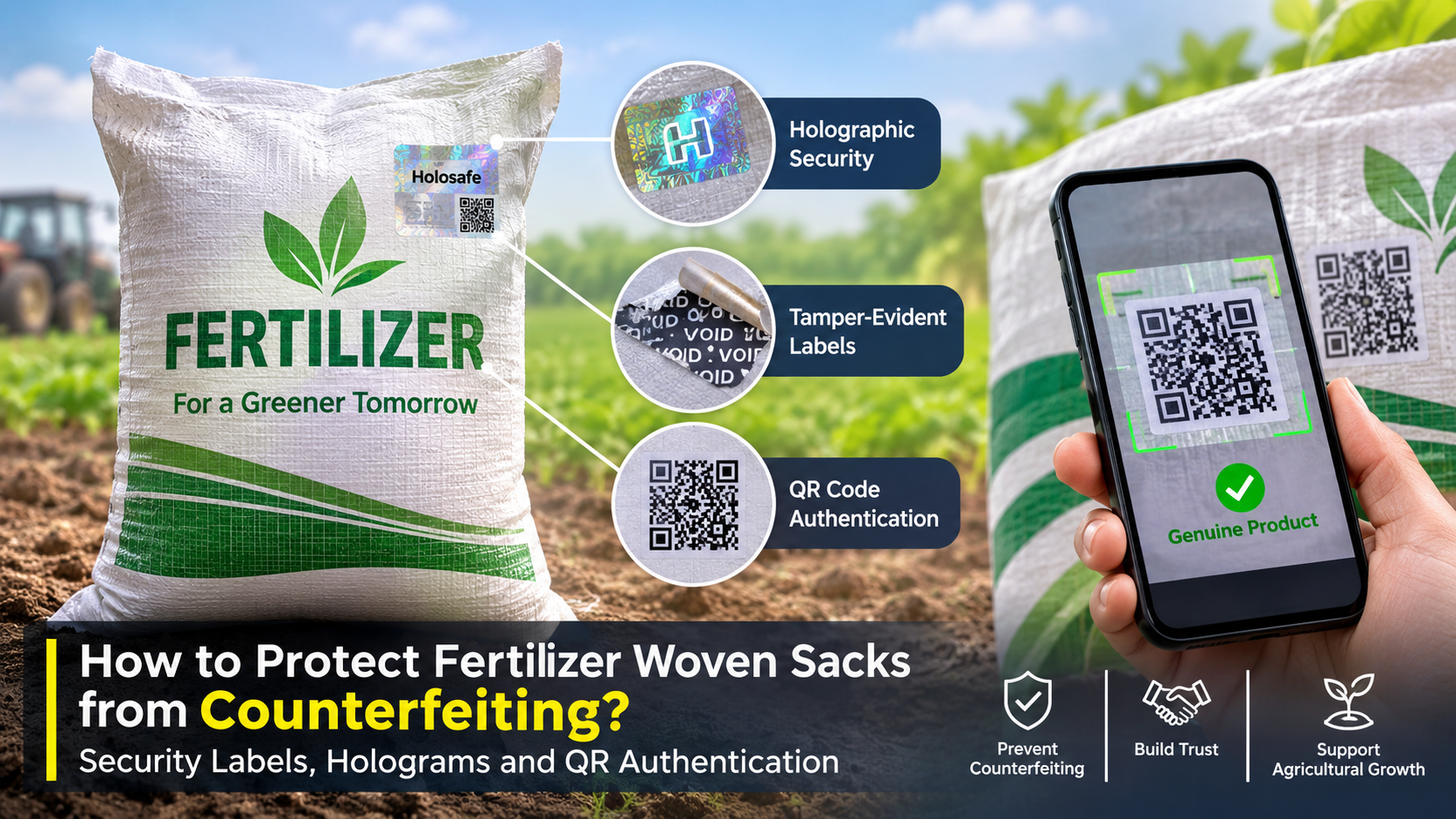
Counterfeit fertilizers are more than a commercial problem. They can affect agricultural productivity, reduce crop yields, damage farmer confidence and negatively impact a manufacturer’s brand reputation.
For fertilizer manufacturers, protecting products against counterfeiting, dilution, unauthorized refilling and packaging reuse has become an important part of supply chain security.
Since fertilizers are commonly packed in woven polypropylene (PP) sacks and bags, implementing effective packaging security requires solutions that can withstand rough handling, moisture, dust, transportation stress and outdoor storage.
This is where advanced Security Label Solutions, holographic packaging, tamper-evident technologies and digital product authentication can make a difference.
By combining physical and digital security features, manufacturers can make genuine fertilizer products easier to identify and counterfeit packaging more difficult to reuse.
Why Is It Difficult to Secure Woven Fertilizer Sacks?
Unlike glass bottles, metal containers or smooth cartons, woven polypropylene sacks have textured surfaces that create specific challenges for packaging security.
Fertilizer bags are frequently exposed to:
- Rough handling during loading and unloading.
- Stacking and movement in warehouses.
- Dust, moisture and rain.
- Direct sunlight and temperature variations.
- Abrasion during transportation.
- Extended outdoor storage.
- Repeated handling throughout distribution.
These conditions can affect label adhesion, print quality, durability and QR code readability.
Therefore, choosing the right Anti-Counterfeit Packaging Labels in India requires more than selecting a security design. Manufacturers must evaluate the compatibility of the label with the actual woven sack material and its operating environment.
1. Implement Tamper-Evident Packaging Solutions
One of the major vulnerabilities in fertilizer packaging is the unauthorized reuse of genuine sacks.
Counterfeiters may open used fertilizer bags, refill them with diluted or inferior products and sell them using the original packaging.
Tamper Evident Packaging Solutions in Noida can help manufacturers address this problem by making unauthorized opening, removal or manipulation more visible.
Depending on the packaging requirements, tamper-evident technologies can include:
- VOID security labels.
- Destructible labels.
- Security cuts.
- Fracture technology.
- Residue-based security features.
- Tamper-evident seals.
These Tamper Proof Security Labels in India can be designed to provide visible evidence when a package has been opened or manipulated.
The objective is to make unauthorized access easier to identify and genuine packaging more difficult to reuse without detection.
2. Strengthen Product Authentication with Security Labels
Tamper evidence indicates possible packaging interference, but it does not independently establish whether the fertilizer inside is genuine.
For better protection, manufacturers can combine tamper protection with advanced product authentication technologies.
Product Security Labels in India can incorporate multiple security features, including:
- Holographic security.
- Unique serial numbers.
- QR codes.
- Variable data printing.
- Covert security elements.
- Authentication identifiers.
These Product Authentication Labels in India provide distributors, dealers and potentially farmers with additional ways to identify and verify genuine products.
A visible security feature can help with initial recognition, while a unique digital identifier or covert feature can provide an additional verification layer.
For manufacturers looking for a reliable Security Label Manufacturer in India, selecting a solution based on product risk, packaging material and distribution requirements is essential.
3. Use Hologram Packaging Solutions for Visual Authentication
Holograms are widely used in product security because they provide recognizable visual features that can help distinguish genuine products from imitations.
Hologram Packaging Solutions can be customized to incorporate brand-specific designs and security elements.
Depending on the application, these may include:
- Custom 2D and 3D holographic effects.
- Kinetic visual effects.
- Micro text.
- Brand-specific holographic patterns.
- Variable information.
- Customized security elements.
- Tamper-evident constructions.
Advanced Hologram Security Solutions can help fertilizer manufacturers establish a recognizable visual identity for their products.
For brands looking for a security hologram manufacturer in India, the focus should be on developing security features that are recognizable to authorized users and difficult for counterfeiters to reproduce convincingly.
Similarly, custom hologram labels manufacturers in India can help develop application-specific holographic labels according to brand identity and packaging requirements.
The purpose of holographic security is not simply to improve packaging appearance. It is to introduce a visual authentication feature that supports product identification and brand protection.
4. Introduce QR Code Authentication for Fertilizer Products
Digital authentication adds another layer of protection to conventional packaging security.
A unique QR code printed on a fertilizer package can connect the product to a digital authentication platform.
With QR Code Authentication in Noida, manufacturers can potentially provide distributors, retailers and farmers with access to relevant product verification information.
Depending on the authentication system, scanning a QR code may provide:
- Product identification.
- Batch information.
- Manufacturing details.
- Authentication status.
- Verification instructions.
- Brand information.
Manufacturers can also explore customizable QR Code Security Labels in Noida to integrate unique identifiers with physical security labels.
However, simply printing a QR code does not guarantee product security. Generic QR codes can be copied.
The effectiveness of QR-based authentication depends on the uniqueness of the identifier and the digital verification system supporting it.
For this reason, manufacturers should consider working with digital product authentication manufacturers in India to develop an authentication system that supports their packaging and distribution requirements.
5. Combine Physical Security with Digital Authentication
A single security feature may not address every counterfeiting risk.
For higher-risk fertilizer products, manufacturers should consider combining multiple technologies to create a layered security system.
A comprehensive approach may include:
Hologram + Tamper Evidence + Destructibility + Serialization + QR Authentication + Track and Trace
Each technology serves a different purpose:
- Hologram: Provides a recognizable visual security feature.
- Tamper Evidence: Helps identify unauthorized opening or manipulation.
- Destructibility: Makes clean removal and reuse of security labels more difficult.
- Serialization: Assigns a unique identity to individual packages.
- QR Authentication: Enables digital product verification.
- Track and Trace: Can provide additional visibility into product movement and scan activity.
Implementing Track and Trace Labels in India can help brands build greater visibility across distribution channels, depending on the supporting tracking infrastructure.
The right combination should be selected according to the product’s counterfeiting risk, packaging format and distribution network.
6. Choose Security Labels Designed for Agricultural Conditions
Fertilizer packaging frequently operates in challenging environments.
Security labels may encounter:
- Dust and dirt.
- Moisture and rain.
- Heat and sunlight.
- Abrasion.
- Rough transportation and handling.
- Long storage periods.
Consequently, manufacturers should evaluate the durability of High Security Labels in India before introducing them into their packaging operations.
Important performance parameters include:
- Adhesion to woven polypropylene.
- Resistance to abrasion.
- Moisture resistance.
- UV resistance.
- Print durability.
- QR code and barcode readability.
- Tamper-indication performance.
- Compatibility with the actual sack surface.
A label that performs well on glass, PET or coated cartons may not deliver the same performance on woven PP.
This makes application-specific testing essential before finalizing the packaging security solution.
7. Protect Other Agricultural Products with Anti-Counterfeit Labels
The counterfeiting challenge is not limited to fertilizers.
Other agricultural products, including seeds, pesticides, crop-protection products and soil treatments, can also face risks associated with product dilution, counterfeit packaging and unauthorized reuse.
Manufacturers can develop a consistent brand protection strategy across their product portfolios using suitable Brand Protection Labels.
Depending on the product and packaging format, this may involve:
- Holographic security labels.
- Tamper-evident seals.
- Destructible labels.
- Unique product identification.
- QR-based authentication.
- Track-and-trace technologies.
The security construction should be evaluated separately for each product because different packaging materials and storage conditions may require different solutions.
8. Maintain Packaging Appearance Along with Security
Packaging security should not compromise product presentation or brand identity.
For fertilizer manufacturers, packaging plays an important role in brand recognition and product differentiation.
Working with a Premium Product Packaging Labels Manufacturer in Noida can help brands integrate security technologies with professionally finished packaging.
Possible features include:
- High-quality printing.
- Brand-consistent graphics.
- Holographic elements.
- Variable information.
- Premium finishing.
- Authentication features.
A well-designed security label should complement the overall packaging rather than appear as an additional element.
This helps manufacturers maintain a consistent visual identity while incorporating product protection and authentication technologies.
9. Why Testing Security Labels on Actual Woven Sacks Matters
Before implementing a security solution, manufacturers should test it on the actual fertilizer packaging material.
A label specification that works on smooth surfaces does not automatically guarantee reliable performance on woven polypropylene.
The evaluation should cover:
- Adhesion and bonding.
- Removal behavior.
- Surface compatibility.
- Abrasion resistance.
- Environmental exposure.
- Print durability.
- QR and barcode readability.
- Tamper indication.
Testing helps ensure that the selected security construction performs under actual storage, transportation and distribution conditions.
How to Choose the Right Fertilizer Packaging Security Solution?
Before selecting a packaging security system, fertilizer manufacturers should consider the following factors.
Identify whether the main concern is counterfeiting, dilution, refilling, unauthorized opening, packaging reuse or unauthorized distribution.
Woven PP, laminated sacks and other packaging formats have different surface characteristics and may require different label constructions.
Determine whether verification will be performed by internal teams, distributors, dealers, retailers or farmers.
Consider outdoor storage, moisture, UV exposure, abrasion, temperature variations and transportation stress.
The security system should be practical for the required production volume and support future SKU and product expansion.
How Holosafe Supports Fertilizer Brands with Packaging Security Solutions
Holosafe offers packaging-security solutions for agricultural products, with a focus on security features suited to demanding packaging and distribution conditions.
Depending on the application, solutions can incorporate:
- Tamper-evident packaging solutions.
- Product security labels.
- Holographic security.
- Destructible labels.
- QR code authentication.
- Serialized identification.
- Anti-counterfeit packaging labels.
- Track-and-trace solutions.
- Premium packaging finishes.
The objective is to develop security constructions that are evaluated against the actual packaging material and the conditions in which the fertilizer will be stored, transported and sold.
For fertilizer manufacturers facing counterfeiting, refilling or unauthorized packaging reuse, the right packaging security solution can help protect product integrity, brand reputation and customer confidence.
Looking to protect your fertilizer woven sacks against counterfeiting?
Connect with Holosafe to explore customized holographic security, tamper-evident labels and digital product authentication solutions for your agricultural packaging requirements.
Frequently Asked Questions (FAQs)
Fertilizer manufacturers can combine holographic security labels, tamper-evident packaging, unique serial numbers, QR code authentication and track-and-trace technologies. The selected solution should be tested on the actual fertilizer packaging material.
Woven PP bags have rough and textured surfaces and are frequently exposed to dust, moisture, sunlight, abrasion and rough handling. These conditions can affect label adhesion, print quality and durability.
Tamper Evident Packaging Solutions are security constructions designed to make unauthorized opening, removal or manipulation visible. They may include VOID labels, destructible labels, security cuts and tamper-evident seals.
Tamper-evident labels can make unauthorized opening and packaging reuse more apparent. Destructible constructions can also make it difficult to remove and reapply the original security label without visible damage.
Product Authentication Labels use security technologies such as holograms, unique serial numbers, QR codes, covert features and tamper evidence to help brands protect products and support genuine product verification.
Holographic security labels provide recognizable visual features such as 2D and 3D effects, micro text, custom patterns and kinetic effects. These features can help authorized users identify genuine packaging and make convincing reproduction more challenging.
Yes. Unique QR codes can connect fertilizer packages to digital authentication platforms. Depending on the system, users can access product identification, batch details, manufacturing information and verification status.
Customizable QR Code Security Labels combine QR-based identification with application-specific label designs and security features. They can be configured to support unique product identification and digital authentication.
Manufacturers should evaluate customization capabilities, holographic security features, brand-specific designs, tamper-evident options, application compatibility and the ability to support production requirements.
They can be, provided the label construction is designed and tested for the expected environmental conditions. Moisture resistance, UV resistance, abrasion resistance, adhesion and print durability are important considerations.
Yes. Depending on the application, a customized security label can combine holographic elements, physical tamper evidence and a unique QR identifier to provide multiple layers of protection.
Serialization assigns a unique identification number to individual packages. When integrated with an authentication system, it can support product verification and help identify duplicate or suspicious codes.
Track-and-trace solutions can provide additional visibility into product movement and distribution. When integrated with suitable digital infrastructure, they can also help brands monitor product identification and scan activity.
Potentially, but each product may require a different label construction depending on its packaging material, environmental exposure and security risks. Application-specific testing is recommended.
Testing on actual woven sacks helps evaluate adhesion, removal behavior, abrasion resistance, environmental durability, print quality, QR readability and tamper performance before commercial implementation.
Look for a manufacturer with capabilities in holographic security, tamper-evident technologies, product authentication, serialization and durable label construction. The proposed solution should be tested on the actual packaging before final approval.
A hologram provides a visible physical security feature that helps with visual recognition. A QR authentication label connects a product to a digital verification system. Combining both can provide physical and digital authentication layers.
Holosafe offers security packaging options that can incorporate holographic security, tamper-evident labels, destructible constructions, QR authentication, serialization and track-and-trace features, depending on the product and packaging requirements.