
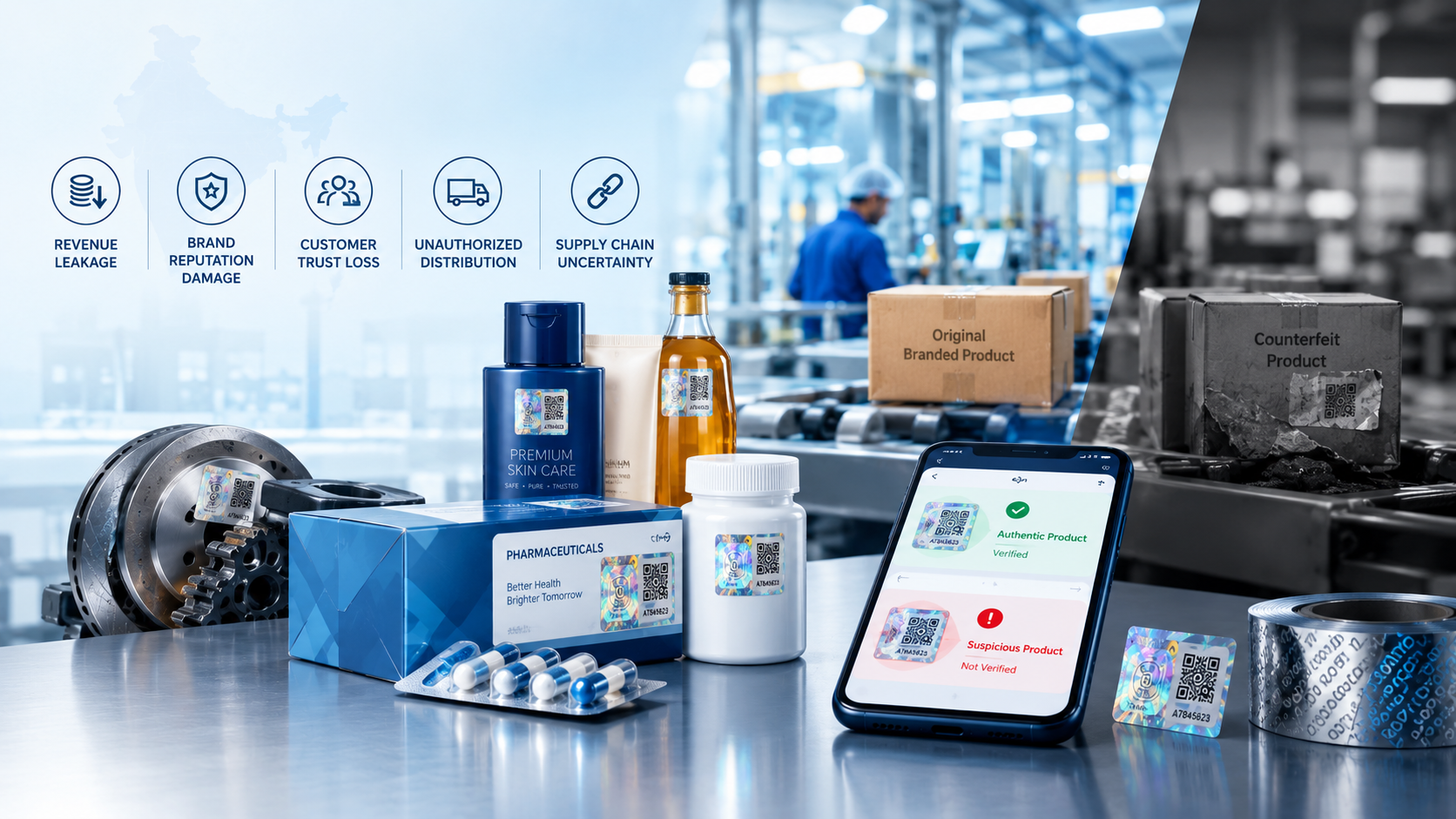
Counterfeiting is often treated as a legal problem — something for the trademark or legal team to address after a fake product has already entered the market.
But for Indian brands, counterfeiting can be much more than an intellectual-property issue.
It can affect revenue, customer trust, distribution visibility, product quality, warranty costs and brand reputation long before a formal legal action begins.
A counterfeit product carrying your brand name can reach a customer who has no way of knowing it is fake. If the product fails, the customer often blames the brand rather than the counterfeiter.
This makes counterfeit prevention an important part of brand protection, product security and business-risk management.
Why Counterfeiting Often Goes Undetected
Unlike a cyberattack or major supply-chain disruption, counterfeiting rarely creates an immediate alarm.
A counterfeit product can enter a distribution network and remain there for weeks, months or even longer before the brand identifies a problem.
Early warning signs may include:
- Unexpected sales declines in specific regions
- Customer complaints about product quality
- Unusual warranty claims
- Products appearing outside authorized territories
- Unexplained distributor activity
- Packaging inconsistencies
- Duplicate authentication attempts
- Unusual product returns
- Price differences across markets
The problem is that these signals are often treated as isolated commercial issues.
By the time they are connected to counterfeiting, the financial and reputational damage may already have occurred.
The Cost of Counterfeiting Goes Beyond Lost Revenue
The most obvious impact of counterfeit products is lost sales.
But the commercial consequences can extend much further.
Brand Reputation
Consumers generally do not know who manufactured a counterfeit product.
If the fake product performs poorly, the brand printed on the packaging is often the one that suffers.
Customer Trust
A customer who receives a counterfeit product may lose confidence in the entire brand.
Rebuilding that trust can be significantly harder than preventing the counterfeit from reaching the customer in the first place.
Warranty and Complaint Costs
Counterfeit products can generate warranty claims, service requests and customer complaints that the genuine manufacturer should never have had to handle.
This can increase operational costs while creating additional pressure on customer-service teams.
Demand and Sales Visibility
Counterfeit products can distort the brand’s understanding of actual market demand.
If unauthorized products are being sold in a territory, sales data may no longer accurately reflect genuine product consumption.
This can affect inventory planning, distributor management and forecasting.
Counterfeiting Should Be Part of the Business Risk Register
If counterfeiting can affect revenue, customer trust and operational costs, it should be treated as a measurable business risk rather than only a legal issue.
That means defining:
- Ownership
- Risk exposure
- Vulnerable products
- High-risk markets
- Prevention measures
- Authentication methods
- Monitoring processes
- Investigation procedures
- Response mechanisms
This is where Security Label Solutions can become part of the business’s preventive-control framework.
Instead of waiting for counterfeit products to appear, security can be built directly into the packaging and product-identification process.
Build Product Protection into Packaging
One of the most effective opportunities to introduce protection is at the point where the product is packaged.
Brand Protection Labels can incorporate multiple physical and digital security technologies depending on the product’s risk profile.
These may include:
- Holographic security
- Tamper-evident labels
- Destructible labels
- Unique serial numbers
- QR code authentication
- Covert security features
- Variable data
- Track and trace
- Product authentication
The objective is to make genuine products easier to identify and counterfeit products more difficult to reproduce convincingly.
Not Every Product Needs the Same Security Level
Counterfeiting risk differs significantly between industries and products.
A low-value, low-risk product may not require the same security architecture as a pharmaceutical product, premium automotive component or high-value consumer product.
This is why security should be based on a risk assessment, not simply on the number of security features available.
Lower-Risk Products
A visible authentication feature combined with basic tamper evidence may be sufficient.
Medium-Risk Products
Brands may consider combining holographic security, tamper evidence and product-level identification.
High-Risk Products
High-value or heavily counterfeited products may require High Security Labels in India incorporating multiple authentication layers.
These can combine:
- Holographic features
- Tamper evidence
- Serialization
- QR authentication
- Covert security
- Track and trace
- Digital product verification
The objective is to avoid relying on a single security feature that can potentially be copied or compromised.
Why Layered Security Is More Effective
A single security feature can provide useful protection, but a layered approach can create a stronger barrier.
Consider a product that uses:
Hologram + Tamper Evidence + Unique Serial Number + QR Authentication
The hologram provides a visible authentication feature.
The tamper-evident construction indicates whether the package has been opened.
The unique serial number gives the product an individual identity.
The QR code connects the physical package with a digital verification system.
Each layer addresses a different aspect of the counterfeit risk.
This is the principle behind modern High Security Labels and advanced product-protection systems.
Product-Level Security Makes Protection Measurable
Traditional anti-counterfeiting measures often focus on identifying counterfeit products after they have entered the market.
Product-level security can move the process toward proactive verification.
Product Security Labels in India can give individual products, batches or packaging units unique identifiers that can be authenticated throughout the supply chain.
Depending on the system, authorized users can potentially verify:
- Product identity
- Batch information
- Authentication status
- Manufacturing details
- Scan history
- Distribution information
This can provide brands with more actionable information than a conventional packaging label.
QR Authentication Adds a Digital Layer
Digital authentication can extend product security beyond physical packaging.
A unique QR code can allow distributors, retailers or consumers to verify a product using a smartphone.
However, a QR code alone should not be confused with a complete security solution.
A basic static QR code can potentially be copied.
More advanced authentication systems can incorporate:
- Unique serialized codes
- Dynamic verification
- One-time authentication
- Duplicate-scan detection
- Product-specific information
- Scan-location analysis
- Authentication alerts
This turns the QR code from a simple graphic into a connection between the physical product and its digital identity.
Track and Trace Can Help Identify Unusual Activity
Counterfeiting and unauthorized distribution often create unusual product-movement patterns.
Track and trace can help brands establish greater visibility into product movement by recording relevant scanning events across the supply chain.
For example:
Manufacturer → Warehouse → Distributor → Retailer → Consumer
If a unique product identifier appears in an unexpected region or is scanned an unusual number of times, the activity can be investigated.
This makes Track and Trace Labels a useful component of a broader product-security strategy.
Tamper Evidence Protects Against Packaging Reuse
Counterfeiters do not always need to manufacture completely new packaging.
In some cases, genuine packaging can potentially be reused or refilled.
Tamper-evident and destructible Product Security Labels in India can help address this vulnerability.
Depending on the construction, an attempt to remove or open the label may:
- Reveal a VOID message
- Leave visible residue
- Break the label into fragments
- Destroy the printed security feature
- Make the label unsuitable for reapplication
This can make it considerably harder to present a reused package as unopened genuine stock.
Anti-Counterfeit Packaging Should Be Product-Specific
There is no universal anti-counterfeiting label that works equally well for every product.
Anti-Counterfeit Packaging Labels in India should be selected based on:
- Product value
- Counterfeit risk
- Packaging material
- Distribution model
- Environmental conditions
- Target market
- Consumer verification requirements
- Production volume
- Supply-chain complexity
For example, a pharmaceutical package may require different security features from an automotive spare part, liquor bottle, FMCG product or seed package.
The packaging environment matters just as much as the security technology.
Physical Security and Digital Authentication Work Together
Modern product protection increasingly combines physical and digital technologies.
A product could carry:
Security Label → Hologram → Tamper Evidence → Serialization → QR Authentication → Track & Trace
The physical layer helps make the packaging harder to replicate or reuse.
The digital layer creates a product identity that can be verified and monitored.
Together, they can provide brands with a more comprehensive approach to counterfeit mitigation.
How Brands Can Build a Counterfeit-Risk Strategy
A practical counterfeiting-risk assessment can begin with five questions.
Identify products with high margins, strong brand recognition, high demand or significant counterfeit activity.
Map markets, distributors and channels where counterfeit or unauthorized products are most likely to appear.
Determine whether customers, distributors or internal teams need physical, digital or both types of authentication.
Evaluate whether genuine packaging could be opened, refilled and resealed without detection.
A security feature becomes more valuable when the brand can monitor authentication activity and investigate unusual patterns.
Measuring the Effectiveness of Product Protection
Counterfeit protection should not be treated as a one-time packaging purchase.
Brands can establish measurable indicators such as:
- Authentication scans
- Suspicious scan events
- Duplicate-code detections
- Counterfeit incidents
- Unauthorized-market discoveries
- Customer verification activity
- Reported counterfeit cases
- Distributor compliance
This allows product security to become part of an ongoing brand-protection program rather than an isolated packaging project.
Why Holosafe Takes a Risk-Based Approach
Holosafe approaches anti-counterfeiting as a product-security and brand-protection challenge rather than simply a label-printing requirement.
Depending on the product and risk profile, solutions can combine:
- Brand Protection Labels
- High Security Labels in India
- Product Security Labels in India
- Holographic security
- Tamper-evident technology
- Destructible labels
- QR authentication
- Serialization
- Track and trace
- Digital product authentication
The objective is to develop a security architecture around the actual product, packaging, distribution environment and counterfeit risk.
This allows brands to move from reacting to counterfeit incidents toward building protection into the product before the risk materializes.
Talk to Holosafe about a counterfeiting risk assessment for your product portfolio and identify the right combination of physical and digital security for your brand.
Frequently Asked Questions
Counterfeiting can affect more than direct sales. It can damage brand reputation, reduce customer trust, increase warranty and complaint costs, distort market demand and create problems for authorized distribution channels.
Consumers often cannot distinguish a counterfeit product from a genuine one. If the counterfeit product performs poorly, the customer may associate the negative experience with the original brand.
Brand Protection Labels are security labels designed to help brands protect products against counterfeiting, tampering, unauthorized distribution and packaging reuse. They can incorporate physical and digital authentication technologies.
Product Security Labels in India are labels that provide product-level security or authentication through technologies such as holograms, serialization, QR authentication, tamper evidence and covert security features.
High Security Labels in India are advanced security labels that combine multiple overt, covert, physical or digital features to provide stronger protection for high-risk products.
Anti-Counterfeit Packaging Labels in India are packaging security labels designed to make unauthorized reproduction, substitution, reuse or manipulation more difficult while supporting product authentication.
A hologram alone cannot guarantee that a product will never be counterfeited. However, customized holographic security can provide a visible authentication feature and can become significantly more effective when combined with tamper evidence, serialization and digital authentication.
QR authentication can help verify product identity, but a basic static QR code should not be considered sufficient protection on its own. Secure systems can use unique serialized codes, dynamic verification and duplicate-scan detection.
Authentication focuses on determining whether a product or identifier is genuine. Anti-counterfeiting is broader and includes the physical and digital measures used to deter, detect and investigate counterfeit products.
Tamper-evident labels primarily show whether packaging has been opened or manipulated. They can also help prevent the reuse of genuine packaging by making unauthorized opening visible.
Track and trace can provide visibility into product identity and movement. Unusual scan locations, duplicate scans or unexpected distribution patterns can help brands identify activity that warrants investigation.
No. Security should be proportional to the product's risk. Some products may require basic tamper evidence and visible authentication, while high-risk products may justify multiple physical and digital security layers.
Evaluate the value and demand of the product, counterfeit history, distribution channels, geographic markets, packaging vulnerabilities and authentication requirements. Then select security technologies based on the specific threat profile.
Yes. A security label can potentially combine holographic security, tamper evidence, serialization, QR authentication, variable data and other technologies within one product-security architecture.
Brands can monitor authentication scans, duplicate-code events, suspicious locations, counterfeit reports, unauthorized-market activity and other relevant indicators. These metrics can help identify emerging threats and measure the effectiveness of the security program.
Once counterfeit products reach customers, the brand may already be dealing with lost revenue, complaints and reputational damage. Building authentication and security into packaging from the beginning allows brands to establish preventive controls before an incident becomes widespread.