
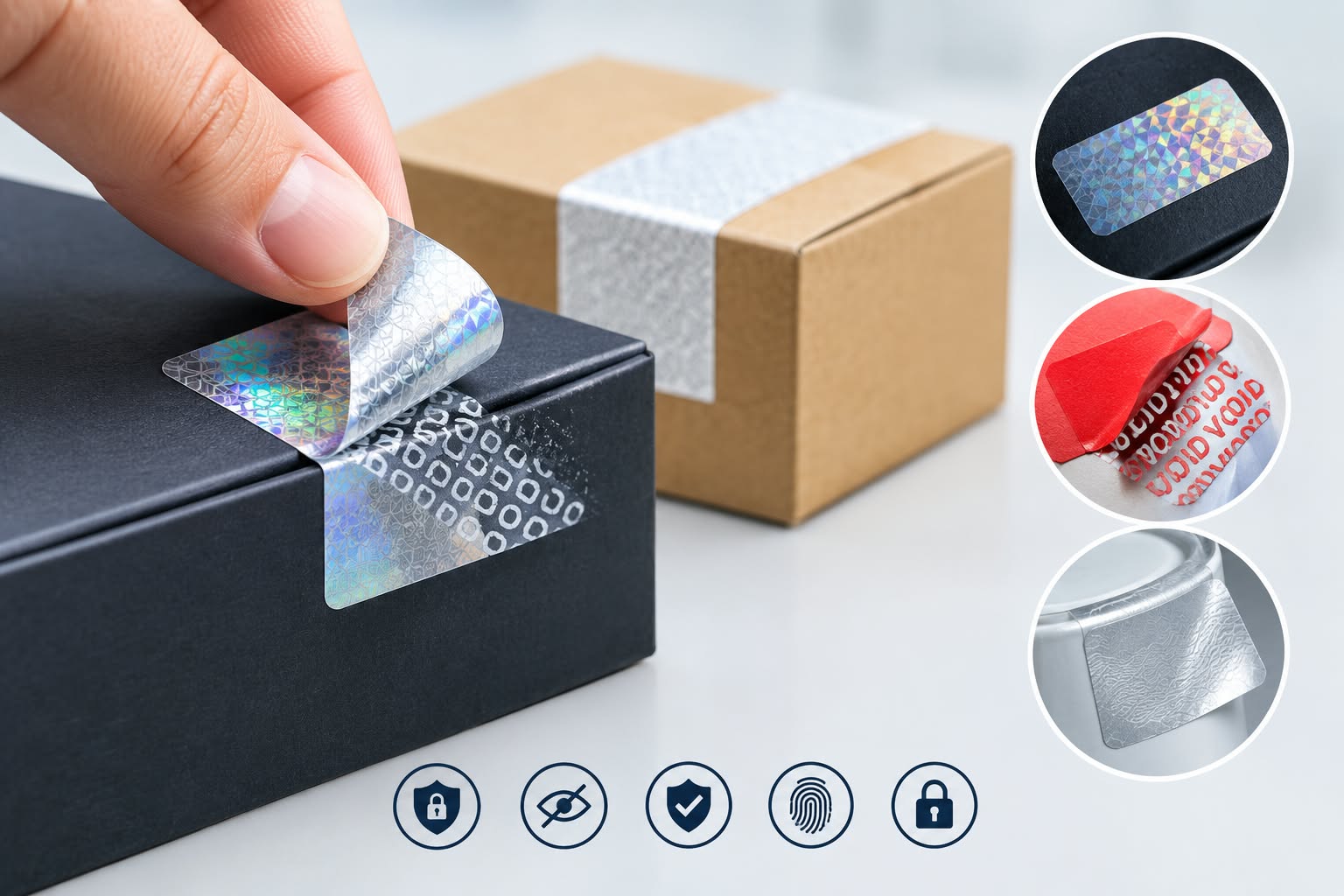
The terms tamper evident and tamper proof are often used interchangeably in packaging and product security. However, they address two different security requirements.
Choosing between them is not simply a matter of selecting a stronger label. The right solution depends on whether your primary objective is to detect and display evidence of interference or to make removal, reuse, or unauthorized access extremely difficult.
For brand owners evaluating Security Label Solutions, understanding this distinction is essential for building effective product protection and preventing counterfeiters from exploiting packaging weaknesses.
What Is a Tamper Evident Label?
A tamper evident label is designed to show that someone has attempted to open, remove, or interfere with a sealed product.
The objective is not necessarily to prevent access. Instead, the label creates visible and permanent evidence of tampering.
Depending on the packaging and security requirement, tamper-evident labels can incorporate features such as:
· VOID or OPENED messages
· Destructible patterns
· Residue or transfer technology
· Color-change indicators
· Fracturing films
· Security cuts and slits
· Holographic security features
For example, when a tamper-evident label is peeled from a package, a hidden message may appear or the label may leave behind a visible pattern. Even if the product has been accessed, the packaging immediately communicates that its original seal has been compromised.
Tamper Evident Packaging Solutions in Noida are commonly used for warranty seals, service panels, electronic products, automotive components, pharmaceutical packaging, consumer goods and secondary packaging where detecting unauthorized access is important.
When Should You Use Tamper Evident Labels?
Tamper-evident construction is particularly useful when your primary concern is:
- Unauthorized opening
- Product interference during transportation
- Warranty or service fraud
- Unauthorized access to components
- Evidence of packaging manipulation
- Maintaining an audit trail through the supply chain
The key principle is simple: the label does not have to stop the attempt; it has to make the attempt visible.
What Is a Tamper Proof Label?
The term tamper proof is commonly used in the security-label industry for labels designed to make unauthorized removal, reuse, or replacement extremely difficult.
Strictly speaking, no packaging label can guarantee that tampering is absolutely impossible. Therefore, tamper-resistant is often a more technically accurate description.
Tamper Proof Security Labels in India can be manufactured using destructible films, highly aggressive adhesives, security cuts, layered constructions and other features that make removal or reuse impractical.
For instance, a destructible label may break into small pieces when someone attempts to remove it. This prevents the original label from being peeled off intact and reapplied to another container.
This makes such constructions particularly useful where simply showing evidence of opening is not enough.
Where Are Tamper Proof Security Labels Used?
Tamper-resistant constructions can be particularly valuable for products where unauthorized refilling, resealing or replacement creates a significant commercial or safety risk, including:
- Pharmaceutical products
- Liquor and beverage packaging
- High-value consumer goods
- Automotive components
- FMCG products
- Electronic products
- Industrial products
- Premium packaged goods
For example, Security Labels for Liquor Bottles in India may need to address both unauthorized opening and the possibility of refilling or resealing.
Similarly, pharmaceutical manufacturers may require security constructions that make unauthorized access immediately apparent while also making label replacement difficult
Tamper Evident vs. Tamper Proof: What Is the Actual Difference?
The simplest way to understand the difference is to consider the primary objective.
A tamper-evident label focuses on detection.
A tamper-resistant or tamper-proof label focuses on resistance and prevention of reuse.
If someone removes a tamper-evident label, the packaging should reveal that interference has occurred.
If someone attempts to remove a destructible tamper-resistant label, the label itself may fracture or become unusable, making it difficult to remove and reapply.
In many applications, however, brands do not need to choose only one approach.
Can Tamper Evidence and Tamper Resistance Be Combined?
Yes. In fact, high-risk products can benefit from combining multiple security technologies.
High Security Labels in India can incorporate several layers of protection within a single construction.
For example, a security label may combine:
- A destructible substrate to prevent clean removal
- A VOID message to indicate tampering
- A holographic element for visual authentication
- A unique serial number
- A QR code for digital authentication
- Track-and-trace functionality
- Security cuts or micro text
- Variable data or batch information
This creates a multi-layered approach to product protection.
A physical security feature can make unauthorized removal difficult, while a digital feature can help verify product identity further along the supply chain.
Tamper Evident Labels for Different Industries
The correct label construction depends heavily on the product, packaging substrate and type of security risk.
Pharmaceutical Packaging
Pharmaceutical products require packaging that can provide clear evidence of unauthorized access.
Pharmaceutical Security Labels Manufacturer India solutions may combine tamper evidence with authentication, serialization, QR codes, holographic features and other security elements.
For high-risk pharmaceutical products, the label should be evaluated not only for its security features but also for its compatibility with the packaging material and storage conditions.
Liquor and Beverage Packaging
Liquor and beverage products are particularly vulnerable to refilling, counterfeit packaging and unauthorized resealing.
Beverage Authentication Labels in Noida and Security Labels for Liquor Bottles in Noida can incorporate tamper-evident, holographic and authentication features to make packaging manipulation easier to identify.
For tax-regulated products, security labels can also be integrated with Tax Stamp Solutions and Liquor Tax Stamp Solutions where applicable.
Automotive Products
Automotive components can be exposed to counterfeiting, unauthorized replacement and warranty-related fraud.
Secure Packaging Solutions for Auto Industry applications can combine tamper evidence with product identification, barcode or QR-based authentication and Brand Protection Labels.
This can be particularly useful for products such as spare parts, lubricants and other aftermarket components.
FMCG and Consumer Goods
Consumer products require security features that are both effective and commercially practical.
Consumer Goods Security Labels in India can combine tamper evidence with holographic protection, authentication and attractive packaging elements without compromising the visual identity of the brand.
For FMCG brands facing counterfeiting, Anti-Counterfeit Packaging Labels in India can provide an additional layer of protection alongside conventional packaging.
Tamper Evidence Is Only One Layer of Product Security
A tamper-evident label should not necessarily be viewed as a complete anti-counterfeiting solution.
Tampering and counterfeiting are related but different problems.
A counterfeit product may use completely different packaging, while a tampered genuine product may involve the unauthorized opening, refilling or replacement of the original product.
That is why brands increasingly use a combination of:
· Product Security Labels in India
· Brand Protection Labels
· Holographic security
· QR code authentication
· Digital product authentication
· Serialization
· Track-and-trace
· Destructible labels
· Tamper-evident constructions
· Tax stamps and security tax labels
For example, QR Code Authentication in Noida can provide a digital layer that allows a user or authorized stakeholder to verify product information, while a physical tamper-evident feature provides evidence of packaging interference.
How to Choose the Right Tamper Security Label?
Before selecting a label construction, evaluate the complete packaging system rather than choosing a technology based only on its name.
1. Identify the actual security risk
Ask what you are trying to prevent.
Is the primary concern:
- Unauthorized opening?
- Refilling?
- Resealing?
- Counterfeiting?
- Warranty fraud?
- Product substitution?
- Supply-chain interference?
The answer will determine whether you need tamper evidence, tamper resistance or a combination of technologies.
2. Consider the packaging substrate
A label that performs well on glass may not perform the same way on PET, HDPE, metal, coated cartons or flexible packaging.
Adhesion, surface energy, curvature, temperature and coating can all affect performance.
3. Test the removal behavior
A professional security label manufacturer should evaluate how the label behaves when someone attempts to remove it.
The objective is to understand whether the label:
- Remains intact
- Fractures
- Leaves residue
- Reveals a VOID message
- Transfers part of the construction
- Becomes unusable after removal
4. Consider authentication requirements
If counterfeiting is also a concern, physical tamper protection can be combined with authentication technologies.
Depending on the product, this could include holograms, QR codes, serial numbers, barcodes or digital product authentication.
5. Test under real conditions
Laboratory performance alone is not enough.
The final construction should be tested against the actual packaging, closure, storage conditions and application process.
A capable Security Label Manufacturer in India should be able to evaluate the proposed construction before finalizing the production specification.
Holosafe's Approach to Tamper Security
At Holosafe, tamper protection is approached as part of a broader Product Security and Brand Protection strategy rather than as a standalone label feature.
Depending on the product and risk profile, the label construction can incorporate tamper-evident technology, destructible materials, holographic security, authentication features and other customized security elements.
The objective is to match the security construction to the actual product, packaging material and threat scenario.
For brands evaluating High Security Labels, Anti-Counterfeit Packaging Labels, holographic security or authentication solutions, testing the construction against the actual packaging is an important first step.
Not sure whether your product requires tamper evidence, tamper resistance, or a combination of both? Contact Holosafe for a product-specific security assessment and packaging compatibility evaluation.